The safest first step is to separate the dogs, stop rehearsing the aggressive behavior, and manage the home before you try to train. In-house aggression usually gets worse when dogs keep practicing it. Start by creating distance, controlling access to shared spaces, and watching for stress signals before either dog reaches a breaking point.
Before you start
Before you change anything, look at what is happening in the house. Note when the tension starts, where it happens, and what each dog is doing right before the problem. Common triggers include doorways, food bowls, toys, resting spots, narrow hallways, attention from people, or one dog approaching the other too quickly.
Dogs often show stress before they snap. Watch for stiff posture, hard staring, lip licking, tucked ears, raised hackles, growling, blocking doorways, or one dog repeatedly trying to leave. Those signs are useful information. They mean the setup is too hard, not that you should push through.
Set the house up so the dogs cannot rehearse the conflict:
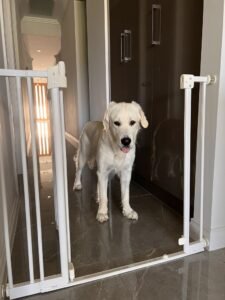
- Use baby gates, closed doors, crates, or exercise pens to keep them apart.
- Feed separately.
- Pick up high-value toys, chews, and bones unless you are actively supervising.
- Give each dog a separate resting area.
- Keep leashes handy for controlled movement through shared spaces.
If either dog has already bitten, or if you cannot safely separate them, skip the DIY plan and get professional help right away.
Step-by-step plan
1. Create enough distance for both dogs to stay calm
Start with the dogs far enough apart that neither one is staring, stiffening, or moving toward the other. That might mean opposite sides of a gate, separate rooms, or one dog on leash while the other is behind a barrier. The goal is calm, not closeness.
2. Control every meeting instead of allowing free access
For now, do not let the dogs wander in and out of each other’s space. Use short, planned sessions only. Keep them predictable: same room, same distance, same setup, and an easy exit for both dogs.
3. Reward neutral behavior
When both dogs can see each other and stay relaxed, quietly reward the behavior you want: looking away, sniffing the floor, lying down, or walking past without tension. Use small treats and keep the session short. You are teaching that the other dog’s presence does not have to mean trouble.
4. End before tension rises
Stop while both dogs are still doing well. If you wait until one dog growls, lunges, or freezes, the session is already too hard. A good session ends with both dogs calm and able to disengage.
5. Increase contact slowly
Only reduce distance if several sessions in a row stay calm. Move in small steps: a gate across the room, then a gate a little closer, then brief supervised time in the same room, and only later looser supervision. If either dog gets tense again, go back a step.
6. Keep management in place even when things improve
Improvement does not mean the problem is gone. Many households still need separate feeding, separate chews, and supervised time together. Think in terms of building calm habits, not proving the dogs can “work it out.”
What to watch for
Stop the interaction early if you see any of these signs:
- Hard staring or fixed eye contact
- Stiff body, frozen posture, or slow, deliberate movement
- Raised hackles
- Lip licking, yawning, panting, or looking away when the setting is not hot or tiring
- Tucked ears or tail
- Whining, barking, growling, or sudden silence after tension
- One dog blocking the other’s path, doorway, bed, or food area
In a normal house, you may see small moments of tension before meals, when someone comes home, or when a dog wants the couch. The important part is whether the dogs can recover quickly. If they cannot, the setup is still too hard.
Common mistakes
- Forcing greetings. A forced nose-to-nose meeting often makes things worse.
- Punishing growling. Growling is often a warning. If you punish it, you may lose the warning without lowering the risk.
- Leaving them alone together too soon. Even dogs that seem fine for ten minutes may not be safe unsupervised.
- Using shared high-value items too early. Bones, food bowls, and favorite toys can raise the stakes fast.
- Moving too quickly. One calm session does not mean the dogs are ready for normal life together.
A common household example: two dogs may seem fine in the living room, but tension appears the moment one dog walks past the other’s crate or the kitchen door. That is a management problem first, not a training failure.
When to get help
Get help from a qualified trainer or behavior professional if the dogs are snapping repeatedly, if there has been a bite, if one dog is guarding food, beds, toys, or people, or if you are not seeing steady improvement after you tighten management. A professional can help you build a safer plan for your specific home layout and dog pair.
If you have children in the home, or if either dog is large enough to injure the other badly, do not try to work through this casually. Safety comes first.
When to call your vet
Call your vet if the aggression started suddenly, seems linked to pain, or comes with other changes such as limping, stiffness, appetite changes, hiding, or unusual sensitivity to touch. Behavior changes can have more than one cause, and pain or illness can change how much a dog can tolerate. If there is an injury, a bite wound, or a dog seems in pain, seek veterinary care promptly.
How to tell it is improving
You are looking for small, repeatable changes:
- The dogs can see each other without freezing or staring.
- They recover faster after a brief trigger.
- They can share space at a greater distance without tension.
- They are easier to redirect with treats, a cue, or a barrier.
- There are fewer growls, snaps, or blocked pathways.
If the dogs still tense up every time they are near each other, the plan is moving too fast. Go back to more distance and simpler setups.
Bottom line: The most reliable way to stop dog aggression towards other dogs in the house is to manage the environment first, watch body language closely, and rebuild contact slowly. Keep the dogs safe, keep sessions short, and bring in a vet or behavior professional early if the problem is escalating.
Sources used
- Cornell Veterinary Medicine on anxious behavior in dogs
- VCA Animal Hospitals on normal and concerning dog behavior

- Is It Safe to Keep Dogs at Home? A Practical Safety Guide - June 17, 2026
- Can Dogs Eat Homemade Chicken Noodle Soup? - June 13, 2026
- Why Is My Dog Getting Anxiety? Common Reasons and What to Do Next - June 11, 2026